

Excerpts from ‘John Adams Collected Works’ by Julia Bullock | Nonesuch Records
Read the entire essay on the Nonesuch website.
Find printed in the program booklet of the forty disc box set of John Adams Collected Works
In 2014, while studying at The Juilliard School, I got a message from my manager that the New York Philharmonic was setting up an audition to have me sing for John in person, because he was looking for a soprano for his Christmas oratorio El Niño. Although excited about the opportunity, I didn’t know the work, so before agreeing to take the audition, I wanted to determine whether I even felt compelled to sing it. I checked out a copy of the score and the audio recording from the Juilliard library… I settled into a small cubicle in the library with a set of headphones, and listened with the score, liner notes, text, and translations in hand.
With a rush of instruments and a hushed choir murmuring syllables that slowly evolved into the word “maiden,” I felt immediately ignited and invested while listening to this recording in solitude. Tears streamed down my face, my thoughts raced. I was transported.
… This work was centered around the fragility of human existence, not human accomplishment. It centered on women, children, and life. Was it the compact and transparent voices of the three countertenors, combined with the unwavering directness of Dawn Upshaw’s delivery, that affected me so deeply? Or the fire and fragility of Lorraine Hunt Lieberson’s voice? For whatever reason, at the end of it I not only wanted to sing John’s music, I felt like I understood what he was aiming to accomplish with it, and also maybe what I could aim to do with it.
…The first piece of John’s that I performed was El Niño, with the LA Phil in December 2016. I remember the experience distinctly, as I often find myself in a hyper-alert state while performing John’s music. But hearing the children’s choir at the end of the oratorio—the clear, untarnished sound of young voices emerging from the sonic haze of the orchestra—was an unforgettable musical moment. It communicated how unwavering stability and resilience can be found in something gentle, even vulnerable. John and Peter were in the audience, and I was honored to lend my voice to a work that I consider to be one of their greatest collaborations.
The next project, scheduled just a few months later, was Doctor Atomic—my first commercial studio recording. I was terrified, in part because I was quite sick with a case of laryngitis going into the recording sessions. For several days preceding I was on complete voice rest. I didn’t dare tell John how delicate I felt, and how careful I thought I needed to be. In retrospect, maybe that delicate nature was perfect for the recording. It led to a certain fragility paired with determined fire that Lorraine Hunt Lieberson always seemed to capture. I tried to center on precision and clarity of the rhythm and words, like Dawn Upshaw always seems to have as her primary focus. But above all, what became paramount was the intention behind my delivery. Since I hadn’t performed the work before, I needed to make explicit decisions on the characterization.
I stood to John’s right side as he conducted. Naturally I wanted him to be pleased, but mostly I wanted to please myself—I wanted to offer a performance that was definitive, not derivative, and I wanted to capture the consciousness of Kitty Oppenheimer, a troubled woman living in a troubled time. Most of Doctor Atomic takes place in the hours leading up to the testing of the atomic bomb on July 16, 1945. There was great anticipation for this scientific development, a “creation” that promised the preservation of some, and the destruction of others. In John’s musical and theatrical interpretation, Kitty Oppenheimer seemed to represent the voice of many, yet didn’t have the ear of anyone. She was combustible, and inexhaustible in how far her expression of thoughts and feelings could extend.
Listening to the recording now, there are some technical mistakes—a few wrong words of Muriel Rukeyser’s poetry, some inaccurate rhythms—but it’s clean and clear as an entire musical offering. And it established this important musical relationship and friendship in my life.
… I’ve since listened back and watched some of the opera [Girls of the Golden West] myself. For obvious reasons, I can’t be fully objective. But what some critics identified as shallowness in the first half of the opera, especially in comparison to the second half, is exactly what I feel John and Peter aimed to frame. They captured and critiqued a certain perception of American history—the one that is typically written and told by white men—which has the habit of not taking full responsibility for its choices, of making a lot of assumptions, and is often presumptuous and proud. It takes the entire first half of the opera for the stereotypes of the Wild West to unfold and collapse. It’s only after this point that the characters reveal the full extent of who they are and what they represent. It is a pointed slap in the face to those accounts of American history which are superficial, incomplete, and highly abridged.
While working on Girls, I told John that I wished there was a moment when all of the women would unite and sing together. He replied that, other than his choruses, he doesn’t write voice ensembles anymore because he can’t tolerate when it’s impossible to understand everyone’s words upon first listening. I thought back to the final scene of Nixon in China and also some parts of Mozart’s sextets, when you can’t grasp every word, but nevertheless there’s power in listening to the overlay of voices, representing a diversity of experiences simultaneously.
… There’s a lot to learn while working on any composer’s music. There’s the technical demands of the composition with which one has to grapple. There’s the comprehension of the music and how that amplifies, conflicts with, or conflates the text and lyrics. There’s also the responsibility of interpreting the intended messages, which need to be internalized, metabolized, processed, and articulated.
But through John’s music, I learned much more. I’ve been surprised by what has been unleashed in my voice and myself while working on his music. Whether I’m being driven to the extremes of my vocal range or psyche, there’s an expectation that I will continue to take risks, and to remain open, available, and ever expansive. No hesitation is allowed. John’s music requires that I trust myself, and it also challenges me to realize that trust. The design of his composing encourages me to focus solely on finding a way to deliver and share the material without obfuscation or obstruction. As a result, it has made me confront how to be less preoccupied with how I am perceived.
He writes three-dimensional representations of human beings, and so his music invites me to have access to all parts of my voice at all times—to not get locked into one way of making sound at any given moment, but to stay conscious, consistent, and self-directed. As a singer, it’s the greatest feeling to know that I’ve become better, stronger, and more capable while working through the challenges of a composer’s music. As a person, there’s nothing greater than feeling freedom and agency.
John imagines the extremes of what an individual dares to express, and finds a way of translating a complex and demanding imagination. His music can be purposefully challenging and grotesque, risky and biting. It calls for our full attention and requires a commitment. He doesn’t shy away, and asks that we don’t either. John doesn’t make claims about his music, but it’s clear when he loves what he’s written and when he hears it realized. It’s fun to see him overjoyed while listening, because he doesn’t hide the delight he takes in his work. Witnessing that has helped me find joy in celebrating my own.
John and I share a mutual understanding and respect—a precedent set at our first meeting. Because of this I’ve never hesitated to ask John for anything. When I asked him if I could take El Niño, his grand oratorio that made me fall in love with his music, and rework it for a distilled chamber ensemble for my residency at the Metropolitan Museum of Art in 2018, he agreed. When I asked to excerpt three of the operatic arias from Girls of the Golden West for a chamber recital with voice and piano in 2021, he agreed. My intention has always been to bring John’s music to as many people as possible, in as many contexts as possible. Yes, John’s music often leaves a big impact on the listener because of its impressive scale, but it’s the intimacy and immediacy of his music that drives me to want to share it.
… it’s undeniable how deeply I’ve been immersed and invested in John’s music. I’ve probably spent more hours of my life pouring over, analyzing, internalizing, and figuring out how to deliver his material than I have on any other composer…
I’m a fan of John Adams. I’m a fan of the scope of human experience his music has the capacity to hold. He’s one of the greats, and how amazing that it’s recognized in his lifetime. He writes music that is classic: it’s classic because we don’t only listen to it one time. We must return to it, engage with it, and reflect on it, with a serious point of inquiry and interrogation. I look forward to seeing what musicians, and in particular singers, will understand about his music and how to deliver it and interpret it as time goes on.
John’s music is about promise and progress. It comments on the inherent threat of exploiting power while embodying it. There’s fire and fragility, placed alongside organized form and frequency. I love John’s music. I love singing it, learning from it. And I love listening to it.
DOCTOR ATOMIC (2018)
Robert Oppenheimer Gerald Finley
Kitty Oppenheimer Julia Bullock
BBC Symphony and Choir
Conductor John Adams
GIRLS OF THE GOLDEN WEST (2024)
Dame Shirley Julia Bullock
Los Angeles Philharmonic
Conductor John Adams
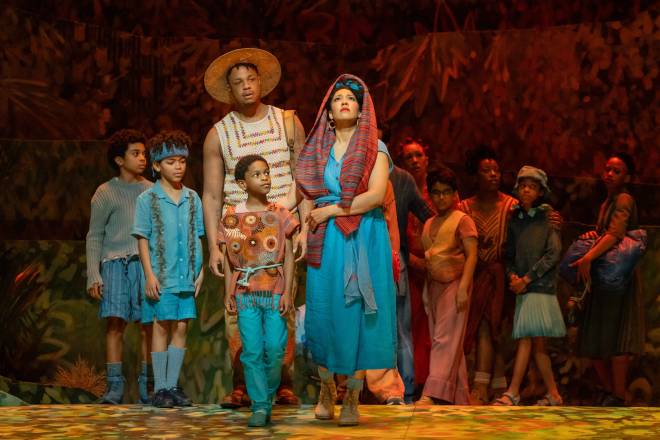


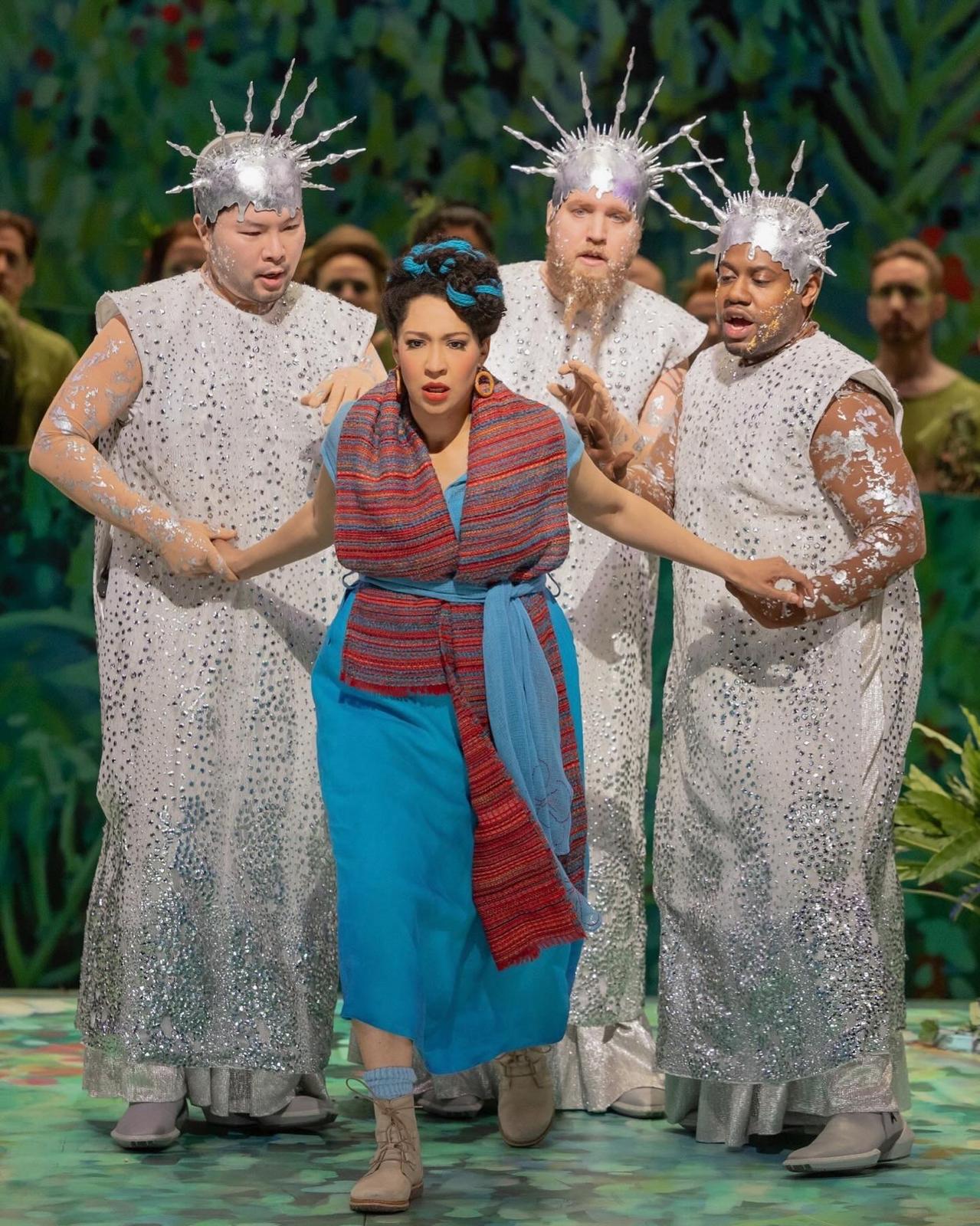
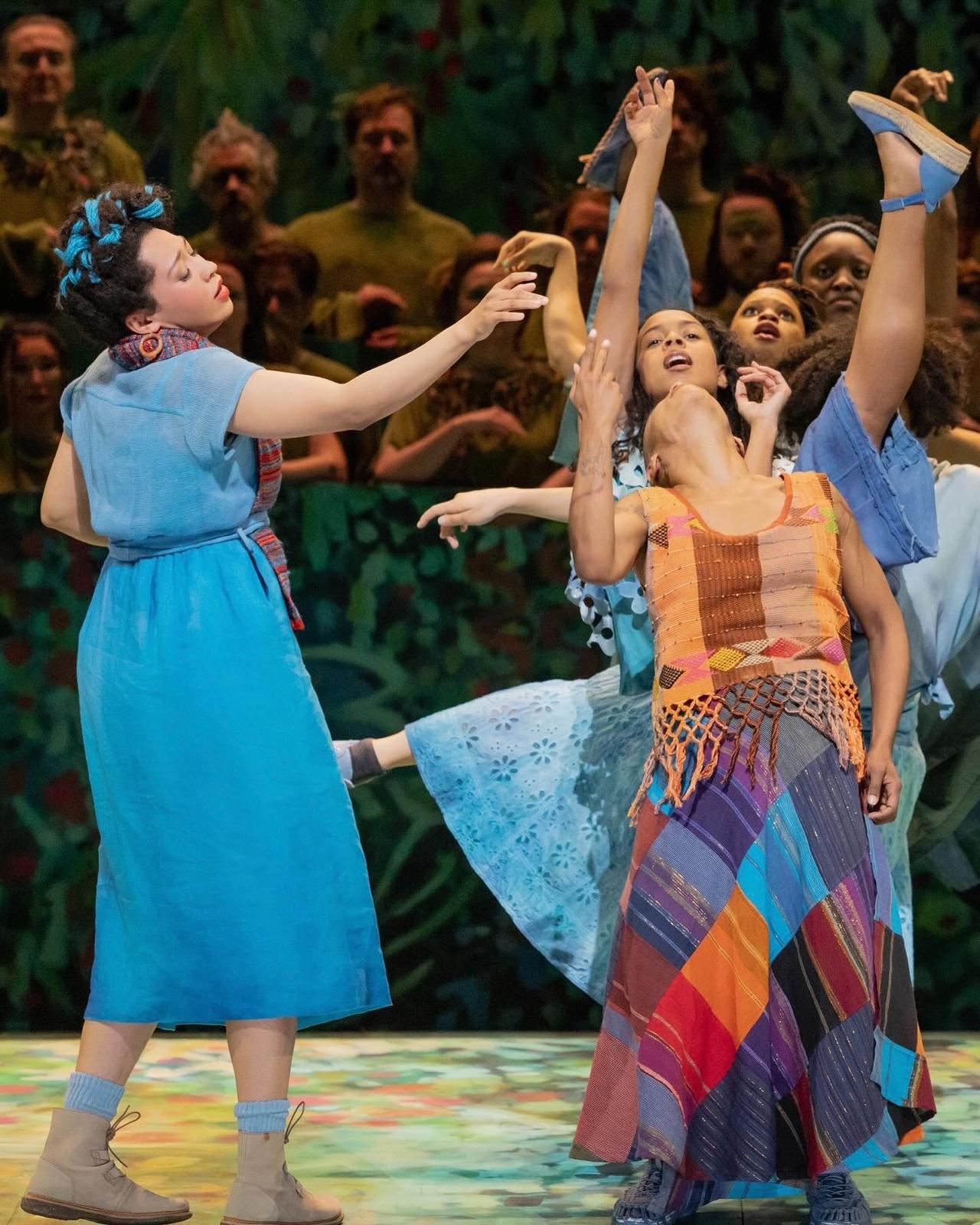

EL NIÑO (2024 live stage performance)
Audio recording from Met on Demand
Soprano Julia Bullock
The Metropolitan Opera Orchestra and Chorus
Conductor Marin Alsop